Thesis: the SaaS platform lets the partner bank offer, under its own brand, a global account that competes with international fintechs and with international credit cards — with predictable costs, transparent FX quotes and FXaaS settlement, without building correspondent banking from scratch.

1. Purpose of the document and the solution
This document sets out the conceptual and commercial pillars of a Global Account SaaS White Label platform for commercial banks — with particular attention to markets with deep regulatory asymmetries (including Angola, Cape Verde, Mozambique and corridors with Brazil).
It is a platform service (SaaS) — not a proprietary banking product. The partner bank embeds the solution in its ecosystem (app, internet banking and core banking) and offers end customers — individuals and companies — an international digital account in foreign currency (USD/EUR and other hard currencies), with the ability to send and receive funds to any country in the world, under the bank’s own brand.
Problem it solves
| Partner bank pain | How Global Account responds |
|---|---|
| Traditional correspondent banking — slow, expensive and opaque | Orchestration hub + FXaaS settlement and near-real-time APIs |
| Customers migrate to global international-account fintechs | White-label offer under the bank’s brand — retention and cross-sell |
| Customers use international cards with opaque costs and statement shock | Quote and cost visible before confirmation; hard-currency savings |
| High capex to build FX and cross-border rails | Plug-and-play SaaS: setup + fee per transaction |
| Fragmented regulatory and compliance risk | Centralised FX intelligence, AML/sanctions and audit trail in the Hub |
2. Value proposition and competitive advantages
2.1 For financial institutions (partner banks)
| Advantage | Commercial rationale | Technical rationale |
|---|---|---|
| New revenue lines | Revenue share on FX spread, send/receive fees and custody charges | Pricing engine configurable by bank, product and volume tier |
| Retention and loyalty | Protects the book against global fintechs and reduces dependence on third-party international cards | Global account inside the existing journey (SSO / deep-link / WebView / SDK) |
| Faster time-to-market | Plug-and-play white label without building FX rails from zero | API-first, OpenAPI, sandbox and certification suite with the local core |
| Regulatory risk mitigation | Centralised FX and cross-border compliance | Secondary KYC, OFAC/UN/PEP screening, purpose codes and audit trail |
| Competitive differentiation | “Connected to the world” bank without correspondent-banking capex | Multi-tenant isolation and per-market branding |
2.2 For end customers — contrast with the international card
A large share of overseas purchases and payments still runs on an international credit card. The issue is not only price — it is opacity.
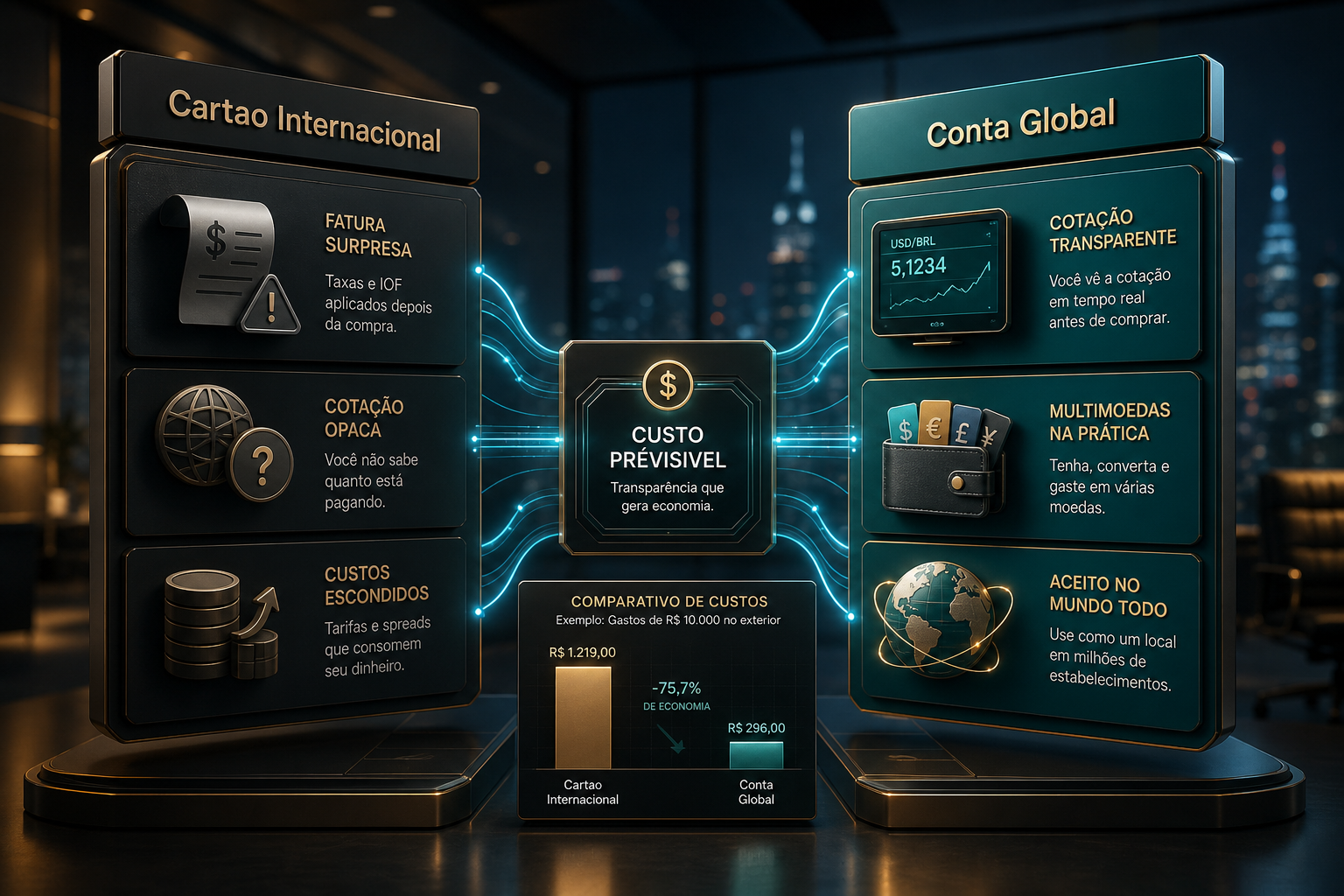
International credit card
- Issuer / scheme FX rate — often unfavourable
- Local taxes / FX markup buried in the price
- “Foreign purchase” or “international cash” fees
- Final amount only appears on the statement — recurring surprise
- Total cost typically far higher than a hard-currency account operation
- No structured way to save in USD/EUR
Global Account (bank white-label SaaS)
- Quote and cost visible before confirmation
- Send and receive to any country
- Savings / reserves in hard currencies (USD/EUR)
- Per-operation cost structurally lower than the card (final pricing after commercial modelling)
- Experience under the local bank brand — trust retained
- Full traceability (purpose code + receipt)
| Dimension | International credit card | Global Account White Label |
|---|---|---|
| Cost predictability | Low — final amount on the statement after markup and fees | High — rate and FX shown before confirmation |
| Effective cost | High (spread + fees + embedded markup) | Materially lower than the card; exact value after pricing |
| Geographic reach | Scheme network (purchases/ATM) | Worldwide send/receive via Hub + FXaaS |
| Hard-currency savings | No (credit balance / debt) | Yes — USD/EUR balance on the global account |
| Statement surprise | Frequent | Eliminated — confirmation at locked cost |
| Relationship with local bank | Often foreign issuer / scheme | Partner-bank product (retention) |
2.3 Further benefits for the end customer
- Multi-currency: send, receive and save — global movement and hard-currency reserves, with near-real-time quote and FX lock via FXaaS.
- Worldwide reach (not Brazil-only) — any country supported by the FXaaS network. Brazil is a transit hub — not exclusive destination.
- Native experience — white-label UI with the partner bank’s brand, colours and copy; the customer stays in the bank app.
- Full transparency — fee, spread, FX rate and purpose code visible before confirmation.
2.4 Differentials versus alternatives
- Not classic correspondent banking — no nostro/vostro account per bank per corridor.
- Not generic fintech white label — the bank remains the local regulatory front; the Hub orchestrates; FXaaS settles.
- Not remittance-only competition — also competes with the international card, where customer pain (cost + surprise) is sharpest.
- Multi-country architecture — one Hub serves multiple jurisdictions with isolated tenants.
3. Business model (SaaS monetisation)
The model aligns technical and financial growth incentives between the SaaS platform and the partner bank (product owner toward the customer).

Setup Cost — fixed initial fee: core homologation, white-label customisation, security channels (mTLS/VPN), API stress testing and compliance onboarding (KYC/AML, purpose codes, reporting).
Transaction Fee — fixed or tiered percentage per successful FX, send, receive or cross-border settlement. Optional revenue share on spread and custody. End-customer pricing defined after commercial modelling.
| Component | Nature | Notes |
|---|---|---|
| Setup | One-time | Amortisable in the bank’s business case over 6–18 months |
| Fee per tx | Recurring | Charged only on successful settlement (success-based) |
| Spread / share | Variable | Negotiable; aligns bank and platform to volume growth |
| End-customer price | To be defined | Below international card and traditional remittance — exact value after pricing |
| Volume tiers (e.g. up to 1,000 / 5,000 / 20,000+ tx/month) with progressive discounts | ||
3.1 Services included in the commercial plan (SaaS scope)
Setup and recurring operations cover the package that makes Global Account live under the partner brand — without the bank building every layer from scratch.
| Associated service | What it delivers | Value for the bank |
|---|---|---|
| Core banking integration | API-first (REST/OpenAPI) connection: authentication, global account open/query, quote, settlement, state webhooks and reconciliation. | Faster time-to-market; Global Account enters the existing journey without replacing the local system of record. |
| Brand and identity customisation | Visual white label: logo, colours, typography, copy and screens (WebView, SDK or portal). | The end customer perceives the product as the bank’s — retention and local trust. |
| Notification system | Transactional and operational alerts (push, email, SMS or bank channels): quote, confirmation, settlement, failure, limits and compliance events. | Customer transparency and fewer call-centre contacts. |
| Custom dashboard and monitoring | Panel with volumes, success rates, statuses, queues and end-to-end traceability (correlation ID / transaction ID). | Visibility for operations, treasury and compliance; audit support. |
| Data protection and security | Encryption, network isolation, mutual authentication, immutable audit and access management. | Ready answers for internal audit, central banks and risk committees. |
3.2 Transaction security and integrity
The platform adopts the same mechanisms digital banks use on cloud infrastructure (market standard, including AWS-class environments) to protect data and guarantee online transaction integrity:
| Mechanism | How it protects the operation |
|---|---|
| Encryption in transit | Mutual TLS (mTLS) and digital certificates between core, Hub and FXaaS — prevents MITM and authenticates both ends. |
| Encryption at rest | Sensitive data encrypted; keys rotated and segregated by tenant. |
| Network isolation (private VPC) | Segregated subnets, VPN/dedicated link — no unnecessary public exposure. |
| Identity and access control | Least privilege, MFA for operators; no shared credentials. |
| Idempotency and transactional integrity | States quoted → locked → settled/failed and event ledger. |
| Immutable audit trail | Who did what, when and with which outcome; configurable retention. |
| Perimeter protection | DDoS mitigation, rate limiting and circuit breakers. |
| Multi-tenant segregation | Data, keys and logs isolated per partner bank. |
| Secrets management | Credentials and certificates outside code; rotation and audited access. |
| Monitoring and detection | Metrics, alerts and correlation of anomalous events. |
4. Generative and multi-agent AI in cross-border compliance orchestration
Expanding Global Account services across markets with deep regulatory asymmetries — including Portuguese-speaking African jurisdictions (Angola, Cape Verde, Mozambique) and their corridors with Brazil — demands more than static compliance rules. To enable a safe, near-instant SaaS White Label operation, we embed a multi-agent AI architecture directly in the FXaaS orchestration hub.

Specialised agents and RAG architecture
Instead of slow manual checks or rigid IF-THEN systems, the platform runs autonomous cognitive agents in parallel:
Ingestion and regulatory-context agent (localised RAG)
Fed by knowledge bases continuously updated with each central bank’s rules (e.g. BNA FX guidelines in Angola, BCV rules in Cape Verde and BCB instructions in Brazil). It performs instant semantic retrieval to ensure the transaction’s nature is strictly aligned with permissions of the source and destination accounts.
Compliance validation agent (multicountry logic)
Orchestrates the flow by dynamically evaluating transactional limits, purpose codes and required documentation — tailored to each currency/country pair. If one jurisdiction requires evidence that another waives, the AI adapts the validation path in the API with no code redeploy at the partner bank.
Fraud detection and behaviour analysis agent
Analyses transactional patterns in milliseconds using machine-learning models and relationship graphs. It flags anomalies outside the end user’s baseline, preventing identity theft, money laundering (AML) and terrorist financing (CFT) before FXaaS settlement.
Practical benefits for partner banks
- Near-real-time decisions — intelligent orchestration evaluates risk, fraud and regulatory fit in under 2 seconds, keeping the end-customer experience instant.
- Sharp drop in false positives — AI contextualises the transaction from history and local rules, avoiding unnecessary blocks that create friction and support load.
- Immutable auditability — every decision produces an explainable AI trail, recording exactly which rule from which central bank justified approval or block of the remittance.
Informational document. Not a binding offer or legal, tax or regulatory advice. The Global Account is offered under the partner bank’s brand; the platform acts as a SaaS White Label provider. End-customer prices will be set after commercial modelling and volume/jurisdiction due diligence. · July 2026