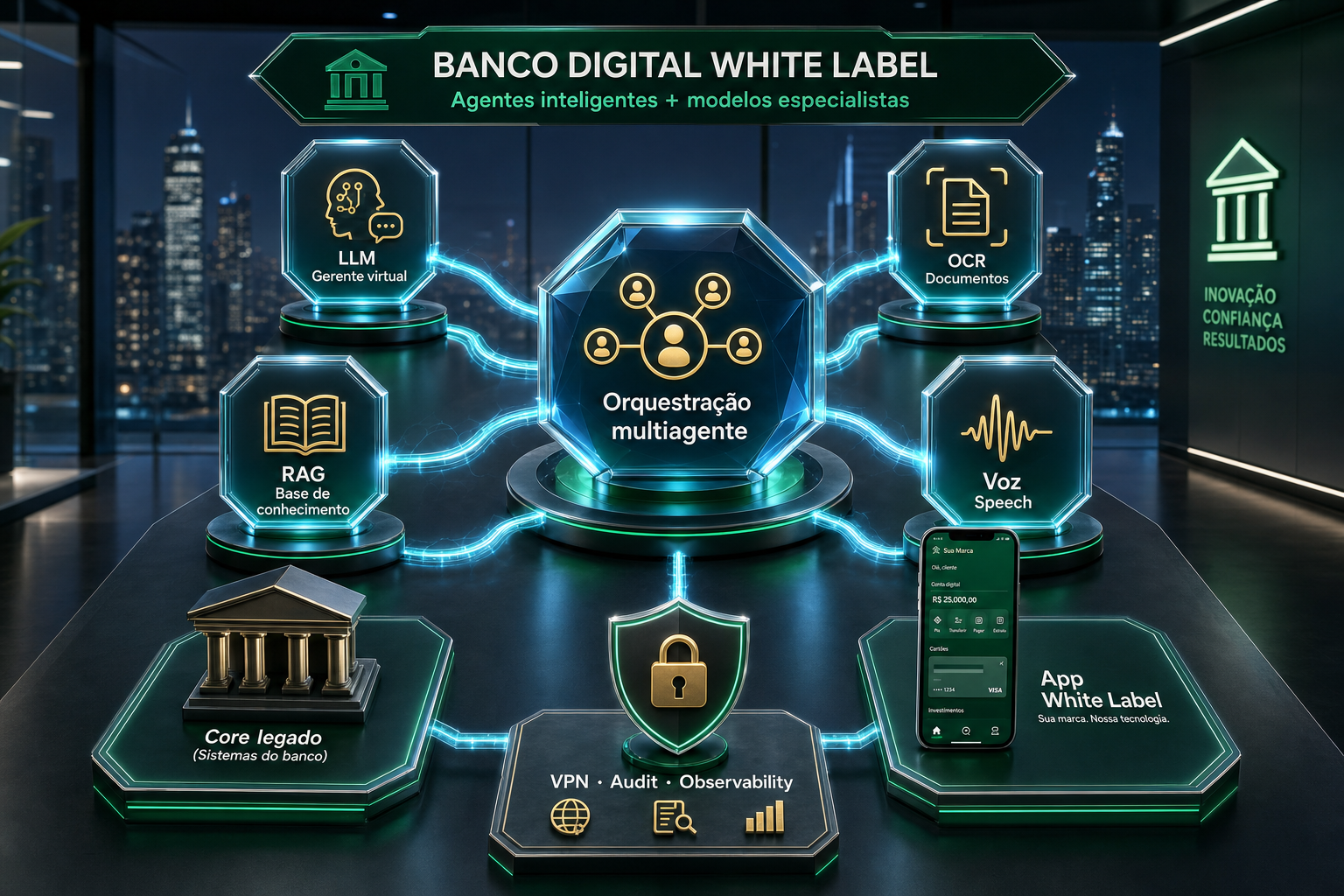
Commercial thesis: what sets this Digital Bank apart is not generic process orchestration (queues and state machines alone). It is multi-agent orchestration on an open tool contract — MCP (Model Context Protocol) — where agents perceive, reason and act with specialist models (LLM, OCR, voice, RAG) and core APIs. The partner bank gains usability and business adaptability without rewriting the monolith, with bank-grade governance (VPN, audit, observability). A white-label solution, already available and in play.
1. What the monolithic core — and “generic orchestration” — do not solve
Traditional banking cores were built for accounting stability and batch. Digital competitors run conversational journeys, document onboarding, voice servicing and products that change weekly. Each new service usually means months of monolithic code.
Orchestrating only with technical workflows (states, retries, queues) improves engineering — it does not create domain intelligence. Customers still face rigid menus; the business still requests sprints for every new rule.
- Complex coding in the monolith — regression risk and slow time-to-market.
- Journeys without a “brain” — without agents, every channel reinvents rules and copy.
- Isolated models — OCR in one silo, chatbot in another, core in another: no cognitive orchestration.
- Fragile audit — hard to explain who (human or agent) decided what.
2. The disruption point: agent orchestration + specialist models
The Digital Bank platform treats orchestration as coordination of intelligent agents, not a static flowchart. Each agent has a goal, tools and guardrails; the orchestrator assigns work, waits for outcomes, compensates failures and writes the audit trail.
| Cognitive layer | Role | Digital-bank examples |
|---|---|---|
| Multi-agent orchestration | Plans, decides, executes and coordinates agents end to end | Full onboarding; payment with validation; servicing with human escalation |
| LLM (language) | Natural-language understanding and generation with customer context | Virtual manager, explained simulations, product guidance |
| OCR / vision | Structured extraction from documents and proofs | KYC, bills, proof of address, virtual card |
| Voice / speech | Spoken input and output in journeys | Service channels, confirmations, accessibility |
| RAG / knowledge base | Retrieves policies, fees and procedures without monolithic hardcoding | Regulatory answers, product FAQs, purpose codes |
| Tools / legacy core | Actions on the system of record via secure APIs | Balance, debit/credit, account opening, ledger |
| MCP (Model Context Protocol) | Open contract that exposes Lambdas/APIs/KB as tools the agent can invoke | AgentCore Gateway: queryBalance, transfer, Retrieve (RAG), compliance |
2.1 Why this is disruptive (and not “AI on a slide”)
| Disruptive factor | What changes in practice | Commercial impact |
|---|---|---|
| Agents at the centre of the journey | The customer chats or acts; the agent orchestrates OCR → rules → core → notification — with states and compensation. | Higher usability; less drop-off; 24/7 contextual service. |
| Pluggable specialist models | Evolve LLM, OCR or voice without rewriting the core; the orchestrator keeps the journey contract. | Fast adaptation to new products and regulation. |
| Knowledge instead of a rules monolith | Fees and policies enter the knowledge base; agents retrieve context at runtime. | Ends “intermediate” screen-and-IF-THEN development in the core. |
| White label + legacy core | Bank brand; system of record intact; VPN, mTLS, audit and observability built in. | Digital time-to-market without full rebuild CapEx. |
2.2 MCP and AgentCore: what changes for a digital bank
MCP is the protocol that standardises how an agent discovers and calls tools — balance, transfer, OCR, Retrieve on the knowledge base — without coupling the prompt to each vendor’s proprietary SDK. In the Digital Bank, banking Lambdas and the Knowledge Base become MCP targets behind an AgentCore Gateway; the Harness orchestrates the model, memory and tool loop.
| MCP + AgentCore advantage | Impact on the digital bank |
|---|---|
| Pluggable tools | New product (card, payroll credit, Global Account) = new Gateway tool — without rewriting the agent or the core. |
| Stable app ↔ agent contract | The channel (app, WhatsApp, WebView) talks to the Harness; banking tools evolve behind MCP. |
| KB as Retrieve, not hardcode | Fees and policies enter the Knowledge Base; the agent searches via Retrieve on the same Gateway. |
| Unified observability | Model traces + tool calls + RAG in one place (AgentCore / CloudWatch) — risk and audit requirement. |
| Less Classic lock-in | Agents Classic enters maintenance mode; AgentCore keeps receiving new models and capabilities. |
| Memory and session | Customer context across turns (and, with actor-id, across sessions) without inventing a parallel store in the monolith. |
| Least privilege per tool | IAM on the Gateway: the agent only invokes authorised Lambdas and KBs — bank-grade governance. |
3. Customer usability + business elasticity
Multi-agent orchestration is the cognitive nervous system of the digital bank: it joins experience, models and ledger in one auditable chain.
3.1 For the end customer
- Agent-guided journeys (text, voice or app) — fewer menus, less friction.
- Documents processed by OCR in-flow, without unnecessary resubmission.
- Answers grounded in the bank’s knowledge base — not free-floating “hallucinations”.
- Visible states and notifications: the customer knows where the operation stands.
3.2 For business and operations
- Adapt without the monolith: new KYC step, product or voice script = agent/flow/knowledge change — not a core release.
- Human-in-the-loop: the orchestrator escalates to a human when risk or policy requires it.
- Compensation and resilience: OCR or core API failure does not leave the ledger inconsistent.
- Feature flags: activate agents/products by segment, country or channel.

4. Knowledge base: ending intermediate monolithic development
In classic cores, every information service becomes code. With a RAG / knowledge base feeding agents:
- Products, regulations and fees enter as versioned content.
- Agents retrieve context at runtime — answers aligned to bank policy.
- The intermediate path (months translating business into monolithic IF-THEN) gives way to content governance + multi-agent orchestration.
5. White-label model and legacy-core integration
Digital Bank is a white-label platform: the customer sees the bank’s brand; MRemittance provides multi-agent orchestration, specialist models and secure connectors.
| Layer | Responsibility | What the bank keeps |
|---|---|---|
| White-label experience | App / WebView / internet banking + voice/chat channels | Brand, commercial policy, channels |
| Multi-agent orchestration | Agents, guardrails, states, compensation, audit trail | Approvals, limits, human-in-the-loop |
| Specialist models | LLM, OCR, voice, RAG — pluggable and evolvable | Usage policies and knowledge content |
| Legacy core banking | System of record (balances, ledger, products) | Accounting, compliance, licence |
| Secure connectivity | VPN / PrivateLink, mTLS, network segregation | Access and certificates |
5.1 Integration with traditional cores — what we deliver
- Connectors and APIs for authentication, balance/statement, debit/credit, onboarding and products — tools agents invoke with explicit permissions.
- Sandbox and certification suite to certify without production risk.
- Coexistence: the core remains the system of record; agents do not duplicate the bank — they orchestrate what the core already does.
6. Observability, audit and security (at rest and in transit)
Agents in a regulated environment need bank-grade governance — included out of the box:
| Mechanism | How it protects and proves compliance |
|---|---|
| Encryption in transit | TLS / mTLS between app, orchestrator, models/tools and core. |
| Encryption at rest | Sensitive data encrypted; keys with rotation and per-tenant segregation. |
| VPN / private link | No unnecessary public exposure of the bank’s internal APIs. |
| Agent decision audit | Who (agent/human) did what, with which input/model/tool and correlation ID. |
| Observability | Metrics, logs, tracing, token cost, alerts and dashboards. |
| Guardrails & least privilege | Granular IAM; tools with explicit permissions; MFA for operators. |
| Transactional idempotency | Retries without duplicating debit/credit on the ledger. |

7. Commercial offer — what the bank buys
| Component | Nature | Value for the bank |
|---|---|---|
| Setup / onboarding | One-time | Core, VPN/mTLS, white label, agent sandbox |
| Multi-agent platform | Recurring | Orchestration, LLM/OCR/voice/RAG, observability |
| Legacy-core integration | Setup + support | Secure tools on the system of record |
| Security and audit | Included | Package for risk, compliance and regulators |
| Product evolution | Roadmap / CR | New agents and knowledge — not the monolith |
8. Who it is for (and who it is not)
Ideal when
- You want agents + specialist models under your own brand
- You already have a core / licence and need digital speed
- You require decision audit, VPN and observability
- You want to adapt journeys without multi-year monolith programmes
- You operate in Brazil, Cape Verde, Angola or similar markets
Not the path if
- You only want a chatbot with no core connection
- You want an “app with no ledger” and no banking tools
- You expect to replace the full core on day one
- You reject governance and an agent audit trail
9. Next commercial step
- Technical discovery — core map, channels (app/voice), VPN and compliance requirements.
- Live demo — orchestrated agents (LLM + OCR + knowledge), observability dashboard and audit trail.
- Setup proposal — white label, specialist models and sandbox → production timeline.
Informational and commercial document. Not a binding offer or legal/regulatory advice. The white-label experience and agents operate under the partner bank’s brand; the legacy core remains the system of record unless otherwise agreed. · July 2026 · MRemittance